
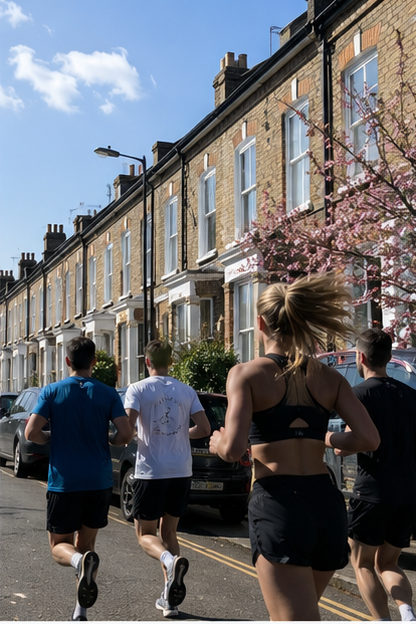
A sensible target 10K pace for most recreational runners in the UK sits between 5:00 and 6:30 per kilometre, which brings you home in roughly 50 to 65 minutes. If you are newer to the distance, 6:30 to 8:00 per kilometre (65 to 80 minutes) is completely normal and nothing to apologise for. The honest answer is that "right" pace depends on your fitness, the course and the day. Below are real average times across the UK, a finish-time-to-pace table you can actually use, and how to find the pace that suits you rather than a stranger on the internet.
What is the average 10K time in the UK?
The average 10K finish time in the UK is roughly an hour, though it varies a lot by data source. Across large, all-comers datasets, RunRepeat's analysis puts the overall median at about 1:02:08, with men around 57:15 and women around 1:06:54. Those numbers include everyone: first-timers, walk-runners and parkrun graduates, not just club racers.
Pull the data from competitive UK races only and the averages drop sharply, to about 46:43 for men and 54:13 for women, because that pool self-selects faster, trained runners. Neither figure is more "correct". They simply describe different groups. If your 10K sits anywhere between 50 and 70 minutes, you are squarely in the normal range for a UK recreational runner, and pace is far more useful to track than where you land against a national average.
10K finish times to pace (per km and per mile)
Here is the practical bit. To finish a 10K in a given time you need to hold the matching pace for the full distance (10K is 6.21 miles). Use this as your race-day reference and pin a target somewhere realistic for your current fitness.
Finish timePace per kmPace per mileRoughly who 40:004:006:26Strong club runner 45:004:307:14Experienced, structured training 50:005:008:03Solid regular runner 55:005:308:51Comfortable recreational 60:006:009:39The "sub-60" milestone 70:007:0011:16Beginner / first 10K To plug in any other goal time, or convert between km and mile pace instantly, run the numbers through our pace calculator rather than doing the long division at 7am on the start line.
What pace should I run my 10K?
Pick a pace you can hold for the whole distance, not the one you can manage for the first kilometre. The classic beginner mistake is bolting off with the crowd, blowing up by 6K, and trudging the last few. A 10K is run only a little faster than your comfortable long-run pace, so most people race it 15 to 30 seconds per km quicker than their easy training pace, no more.
The reliable way to set a target is from a recent shorter result. If you have a parkrun time, your 10K pace will be roughly 15 to 20 seconds per km slower than your 5K pace. Feed a recent 5K (or 10K) into our race time predictor and it will estimate an honest 10K target and the pace to hold. Aim to run the first half a touch slower than goal pace and the second half a touch faster. Negative splits feel brilliant and almost always beat going out hard.
Average 10K times by experience level
Pace expectations should track your training history, not your age or ego. As a rough guide for UK runners, beginners on their first 10K commonly finish in 65 to 80 minutes; consistent recreational runners land around 50 to 60 minutes; and runners following a structured plan with interval and tempo work often dip under 45 minutes.
Experience levelTypical 10K timeTypical pace per km Beginner (first 10K)65–80 min6:30–8:00 Recreational regular50–60 min5:00–6:00 Experienced / structured42–48 min4:12–4:48 Competitive club runner35–42 min3:30–4:12 These are bands, not verdicts. The single biggest lever on your time is consistent weekly mileage at an easy, conversational pace. The NHS Couch to 5K framing holds at every level: most of your running should be slow enough to talk in full sentences.
How to actually get faster at 10K
Run more often, run most of it easy, and race rarely. That is the unglamorous formula behind nearly every personal best. Three to four runs a week, with the bulk at a conversational pace and one harder session (intervals or a tempo run), will move your 10K time more than thrashing yourself every outing. Progress comes from accumulated easy miles, not heroics.
The other lever is showing up. People who train with others run more consistently and quit far less often, because a Tuesday session you have RSVP'd to is much harder to skip than a solo run you can talk yourself out of. If you have been training alone, finding a group near you is one of the fastest ways to add structure for free. Browse run clubs near you and find a pace group that matches your target, then let the weeks of steady mileage do the quiet work.
Frequently asked questions
What is a good 10K time in the UK?
For a recreational runner, anything under 60 minutes is a solid benchmark and under 50 minutes is genuinely good. Breaking 45 minutes usually means structured training. "Good" is relative, though: a personal best beats any national average every time.
What is the average 10K time for a beginner?
Most beginners finish their first 10K in 65 to 80 minutes, a pace of roughly 6:30 to 8:00 per kilometre. That often includes short walk breaks, which is completely fine. Finishing comfortably and uninjured matters far more than the clock on your first attempt.
Is a 60-minute 10K good?
A sub-60 10K is a popular and respectable milestone, requiring a steady 6:00 per kilometre throughout. It sits near the average for UK recreational runners. For many people it is the first big goal after moving up from parkrun and the 5K distance.
How much faster is 10K pace than easy pace?
Most runners race a 10K about 15 to 30 seconds per kilometre faster than their easy training pace. Compared with 5K pace it is roughly 15 to 20 seconds per kilometre slower, since you are holding the effort for twice the distance.
Once you have a target, the rest is repetition. Set a realistic pace with the pace calculator, sanity-check it against a recent result in the race predictor, then find people to run the weekly miles with. That, far more than any average time, is what gets you across the line where you want to be.
